Why Are California’s Ocean Waves So Wild?
Ever stood on a California beach, just watching the big Pacific rollers crash, and wondered what the heck’s actually going on? Beyond the warm sand and the relaxed atmosphere, there’s some deep, seriously cool stuff happening. It’s all about Understanding Ocean Waves. Turns out, these simple movements hide some truly wild secrets about physics, how we see things, and even our own lives.
Freak waves were once dismissed as myths. Now we know, they’re real. Just like Hokusai drew them!
For centuries, artists like Hokusai sketched these huge, gnarly waves – remember his famous “Great Wave off Kanagawa,” looking like it wanted to eat helpless fishing boats? Scientists mostly brushed them off. Oceans, they figured, were orderly. Predictable. Governed by boring math. Sailors’ stories about sudden, 100-foot walls of water appearing from nowhere? Pure imagination.
Then, New Year’s Day, 1995. Off the coast of Norway, scientific gear on the Draupner oil platform detected something impossible. Surrounding waves averaged only 30-40 feet. An 85-foot monster slammed into the rig. Bang.
This wasn’t a fairy tale anymore. Hokusai’s wild vision? Real. Roaring, “Surprise!” And another thing: It proved rogue waves are a hella real force of nature.
Here’s the kicker: Ocean waves move energy, not tons of water, and they travel forever
Okay, next time you’re at the beach, here’s a brainteaser: Waves aren’t really water. Yeah, I know. Sounds super weird, right? But think about your voice. It’s not “made” of air. Air just carries the sound.
Waves? Same deal. What you actually see rolling across the ocean isn’t some giant blob of water moving from one place to another. It’s energy. The individual water molecules pretty much stay local, just bobbing up and down, circling a bit.
Imagine a plastic duck in a wave tank. A wave passes. The duck doesn’t surf off with it. Nope. It bobs up. Bobs down. Goes back to where it started. That’s the water. But the energy? That just keeps on pushing forward.
Because it starts with the sun warming Earth, which makes wind. Wind then shoves its energy onto the ocean’s surface, starting as tiny ripples. More energy builds up, and gravity takes over. The invisible energy of the air just turns into a flat pushing motion on the water. Even when the wind dies, that energy doesn’t peace out. It keeps cruising. Thousands of miles. And remember: Energy never gets destroyed; it just changes form.
That sound of crashing waves? It’s billions of tiny, shaking air bubbles, a full-on ocean band
That huge roar, that soothing rumble when waves hit the sand? Most of us just think it’s water slapping water, or rocks. But scientists found something wilder: The ocean’s sound? A whole orchestra.
Billions of tiny air bubbles. Simple stuff.
When a wave finally breaks and explodes into white foam, it traps air. These itty-bitty bubbles then shake, puff up, and shrink in an instant. Each one is like a little drum. Makes a specific “ping” depending on its size.
If they were too small, we couldn’t hear ’em. Too big, and their pitch would be outside our hearing. But, like so many delicate balancing acts in the universe, these bubbles shake at just the right pitch for us to catch.
And thousands upon thousands of these little bells ringing all at once? That creates the amazing wave music we all love. Straight up, an ocean symphony.
What looks still often isn’t. It’s an illusion. Because we just don’t watch things long enough
We’re built to see the world in snapshots. A painting of a big wave looks frozen, on a wall for a hundred years. But that’s a trick. The universe itself always flows. Always. Full of waves – sound, light, quantum bits. But we really only see water waves, which makes them super inspiring.
And why? Because the difference between something being a static object or a constant movement depends totally on how long we actually look at it. A historic building seems like a solid thing to us. Our lives are short, compared to its whole deal. But over centuries, it’s a process. Building. Expanding. Then, eventually. Falling apart.
Even mountains, which seem totally unmovable, are just geological waves. Slowly moving over hundreds of thousands of years.
You? Me? We’re kind of like waves too. Always changing. Temporary forms of pure energy
And this is where Understanding Ocean Waves gets really deep. Just like a wave, we aren’t static objects. We are processes. Our bodies? Made of atoms. Always changing. We take in oxygen, push out carbon dioxide. Swapping atoms through food and water. This “metabolism” is a constant stream of atoms and molecules coming in and leaving us. Seriously, very few atoms from your childhood body are still with you now.
What really makes us us is that constant river of energy passing through us from the moment we begin to the moment we stop. We’re always in a state of burning and changing, just like those traveling waves.
When that energy flow quits, we become just a pile of parts. Just like a wave, with its energy gone, becomes still water.
Death isn’t an end. It’s just new energy. Like a wave hitting the shore, turning into sound and heat and a big push
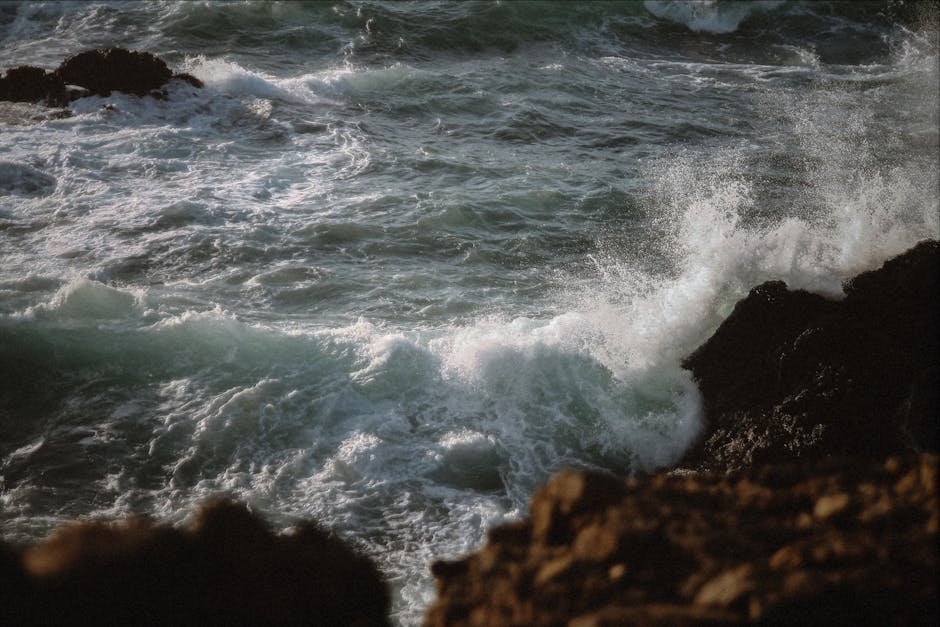
When a wave finally gets to the shore after traveling thousands of miles, its journey ends. The bottom drags on the rising seabed. Slows it down. But the top keeps plowing forward. Eventually, the wave topples. It breaks.
It’s a huge moment. But it’s not destruction. Remember: Energy never disappears. As the wave “dies” on the coast, its energy transforms. Part of it becomes the powerful sound we hear. Some becomes heat from rubbing against the sand. And some of that pushing force moves the pebbles and sand.
The wave, as a distinct shape, is gone. But its energy lives on. Flows into new forms. So too with us. Death isn’t a finish line. It’s just a completion. A release of energy that goes back into everything, leaving its mark. Much like the echo of a crashing wave on the California shore.
Next time you eyeball the ocean, remember: You’re not just watching water. You’re watching yourself.
To truly get what the ocean’s energy is all about, really look close at the details: the shifting sand. The different sounds of the surf. Even on separate parts of the same beach.
FAQs (Fast Answers for Curious Folks)
Do waves really schlep water across big distances?
Nah. Ocean waves mostly move energy, not water itself. Water bits just move in circles, but they don’t go far with the wave.
How far can wave energy travel?
Amazingly far! Think waves from Antarctic storms. They’ve been known to go over 11,000 miles, hitting Alaska in about two weeks. Wild.
What makes the sound when waves crash?
The sound of crashing waves is mainly caused by billions of tiny, shaking air bubbles caught in the water as the wave breaks. These bubbles wiggle at pitches we can hear. Kinda like nature’s own band.